
Home › Writing › Proofreading
What kōsei means: proofreading in Japanese publishing
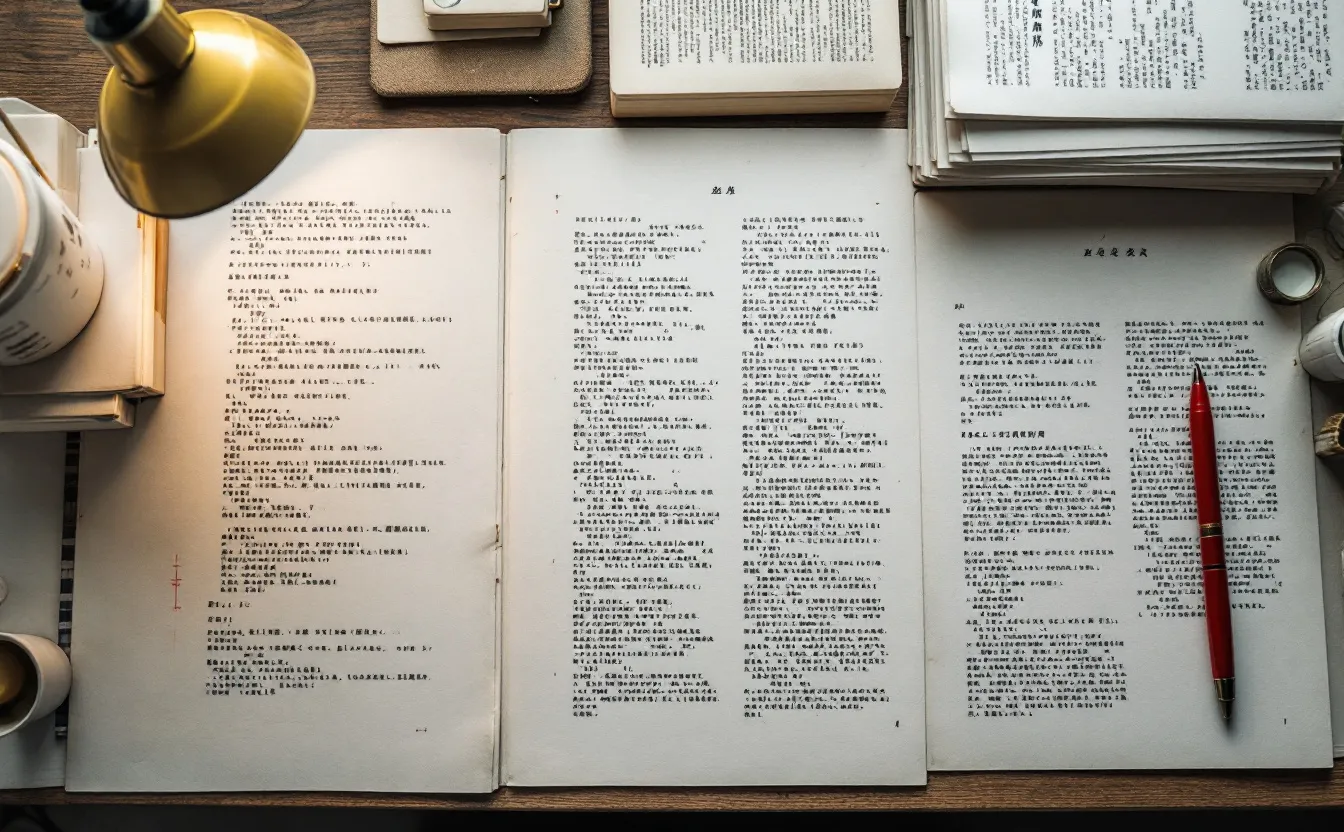
The usual dictionary gloss for 校正 (kōsei) is "proofreading", and that is close enough for a menu or a job title. Inside Japanese publishing, though, the word has a narrower meaning, a partner word that covers what it leaves out, and a whole vocabulary of proof rounds around it. Knowing that vocabulary helps if you work with Japanese editors, if you are asked to "do kōsei" on someone's text, or if you simply want a better routine for checking your own drafts.
This piece walks through the two core words, the stages a printed text passes through, and the marks that travel with it. Then it maps the same stages onto something most of us do far more often: checking a draft before it goes live on the web.
Two words, two kinds of attention
校正: comparing the proof with the copy
In the strict publishing sense, 校正 means checking a proof against the manuscript it was set from. The 校 in the word carries the sense of comparing, and 正 is "correct". The question a kōsei pass asks is narrow and mechanical: did the text survive typesetting intact?
That covers missing or extra characters, a wrong kanji introduced during input, swapped lines, wrong fonts or sizes, ruby (furigana) placed over the wrong characters, page numbers, running heads, and line-breaking rules. Japanese typesetting has its own set of those, called 禁則処理 (kinsoku shori): a line should not begin with 。 or 、 or a small kana such as っ, and should not end with an opening bracket such as 「.
There are two classic ways to compare. In 突き合わせ (tsukiawase), one person lays the proof beside the manuscript and checks them line by line. In 読み合わせ (yomiawase), one person reads the manuscript aloud, punctuation included, while another follows the proof. A third pass, 素読み (suyomi), sets the manuscript aside and reads the proof on its own, as a reader would. It catches what comparison misses, such as an error that was already in the manuscript.
In everyday Japanese, 校正 also has the broader meaning of correcting mistakes in any text, which is why it appears on proofreading services and in software names. When a Japanese colleague says 校正 about a web page, they usually mean that broader sense.
校閲: checking what the text says
校閲 (kōetsu) is the content check. 閲 means to inspect or look over. Where kōsei asks whether the proof matches the copy, kōetsu asks whether the copy itself is right: are the dates, names, figures and quotations accurate, does the text contradict itself, is a place name spelled the way the place spells it, could an expression cause offence or legal trouble. In fiction it extends to internal logic, such as a character's age, the day of the week, or a train that leaves before it arrives.
Newspapers and large publishers employ specialist 校閲者 (kōetsusha) for this work. Their queries go back to the author and editor as questions, not as changes, because the author decides.
The two side by side
| 校正 (kōsei) | 校閲 (kōetsu) | |
|---|---|---|
| Main question | Does the proof match the manuscript? | Is the content correct and consistent? |
| Compared against | The manuscript | Reference sources, the rest of the text |
| Typical finds | Missing characters, wrong kanji, layout and line-break faults | Wrong dates, misspelled names, contradictions, doubtful facts |
| Attention | Close, character by character | Wide, reading for sense |
Job listings and service menus often pair them as 校正・校閲, and the boundary blurs in practice. It is still a useful split, because the two kinds of attention fight each other. If you read for sense, your eye slides over a missing particle. If you read character by character, you stop following the argument. Professional workflows keep them as separate passes for that reason, and so can you.
A third word sometimes gets mixed in: 添削 (tensaku), which is the correcting of a learner's writing by a teacher, with comments on grammar and expression. If you want someone to improve your Japanese rather than check a text for publication, 添削 is the word to use.
From first proof to sign-off
The printed proof is called ゲラ (gera), from the English "galley", or ゲラ刷り (gerazuri). A book or article usually goes through these stages:
- 入稿 (nyūkō): the finished manuscript goes to the typesetter.
- 初校 (shokō): the first proof comes back. This is where most corrections are made. The proofreader compares it with the manuscript, and a kōetsu check often runs at the same stage.
- 著者校正 (chosha kōsei), often shortened to 著者校 (chosha-kō): the author receives the proof, together with the proofreader's queries, answers each query, and marks any changes of their own.
- 再校 (saikō): the second proof, with the corrections applied. The main task is to check that every correction was carried out exactly as marked, which is called 赤字照合 (akaji shōgō). The lines around each change get a careful look too, because a correction can push text onto the next line and disturb what follows.
- 三校 (sankō) and 念校 (nenkō): a third proof, and a final "just to be sure" proof, if the text still needs them.
- 校了 (kōryō): the proofs are signed off, and nothing more changes. A related term, 責了 (sekiryō, short for 責任校了), means sign-off with a few small corrections still outstanding, which the printer makes on its own responsibility without sending another proof.
If you hear 校了しました in an email from a Japanese editor, it means the text is final. Any further change now costs time and goodwill.
Red ink and pencil
Corrections and queries are kept visibly apart. A correction written in red, an 赤字 (akaji, "red characters"), is an instruction: change this. To 赤を入れる (aka o ireru, "put in red") means to mark corrections on a proof. A query written in pencil, often called 鉛筆 (enpitsu) or エンピツ, is a question for the author: "this date differs from page 12, please check". The author either turns the pencil into red or leaves it, and the proofreader does not decide on the author's behalf.
The marks themselves are standardised in the Japanese Industrial Standard JIS Z 8208, which covers printing proof correction marks. A few appear constantly in the margins: トル (toru, "delete"), トルツメ (torutsume, "delete and close up the space"), トルアキ (toruaki, "delete and leave the space"), and イキ (iki, "keep as it was", the equivalent of "stet").
The same rounds for a web draft
Most Japanese text today never sees a galley. It goes from a document or a content editor straight to a screen. The stages still make sense, and they map across with little effort:
| Publishing stage | On a web draft |
|---|---|
| Manuscript | The draft in your editor or shared document |
| ゲラ (proof) | The preview, as it will appear, at desktop and phone width |
| 初校 | A first full read of the preview, plus mechanical checks |
| 校閲 | Checking facts, figures, names, links and quotations against their sources |
| 著者校正 | The writer reviewing the editor's changes and answering queries |
| 再校 | Checking that each change was made, and rereading the lines around it |
| 校了 | Publishing. After this, any correction is a new round, so keep a note of it |
Why the preview and not the draft? Because the preview is your galley. Headings wrap differently, a full-width space shows up as a gap, a line can start with a stray 、, and a table can break on a narrow screen. You only see those in the form the reader will see.
A routine for one person
If you are the writer, the editor and the proofreader all at once, the rounds still help. A possible order:
- Finish the draft and leave it alone for a while. Even an hour makes your own text look less familiar.
- Run the mechanical pass. The checker on the front page handles a slice of the kōsei side: doubled particles, half-width katakana, mixed width digits, mixed polite and plain endings, known spelling pairs. The legend of issue types explains each finding and when to leave it.
- Read the preview on its own, without the draft beside it. This is your 素読み.
- Do a separate kōetsu pass with a short list: every number, date, name, product name, link and quotation, each checked against where it came from.
- Fix everything, then check the changed lines and the sentences next to them. This is your 再校, and it is where new slips usually hide, such as a particle left behind after a rewrite.
- Publish, and stop editing. If you find something later, correct it as a separate, deliberate change.
When you check someone else's text
Borrow the red and pencil split. Make clear corrections directly (a doubled を, a wrong 一同 in 一堂に会する). Put anything that involves meaning, tone or fact in a comment addressed to the writer, phrased as a question. A comment such as "Is this 意外 (unexpected) or 以外 (other than)?" respects that the writer knows what they meant, and it leaves a record of why the text changed.
Questions readers ask
Which word should I use when offering proofreading to a Japanese client?
Use 校正 for checking typos, characters and consistency, and 校閲 if you also check facts and content. 校正・校閲 covers both. If what you offer is closer to rewriting, say so separately, since neither word implies changing the style.
Can software do kōsei now?
Software does a good share of the mechanical side, because many of those problems are patterns. It cannot do kōetsu, which depends on knowing what the text means and what is true. How to use the checker sets out what a rule-based tool cannot see.
Is 校了 the same as "approved"?
Close. It means the proofs are final and the text goes to print or to publication as it stands. In an office email it is a signal that the window for changes has closed.
More in the same section

Hyōki yure: keeping spellings consistent across a long Japanese document
A step by step routine for hyōki yure: pick one spelling per word, write a style sheet, and search a long Japanese document without breaking it.
Open it ›
IME conversion errors: the henkan slips that spellcheck never sees
Why homophone slips like 以外 and 意外 or 保証 and 補償 survive every spellcheck, how IMEs cause them, and a routine for catching them in your Japanese drafts.
Read on ›